购物车Mentech Mall
集团网站Group Website
EN
CN EN

Automotive Inductors in New Energy Vehicles: Application and Research 2025

2025-10-10

With the rapid development of Advanced Driver Assistance Systems (ADAS), vehicle electrification, and the Internet of Vehicles (IoV), the complexity of automotive electronic systems has grown exponentially. Against this backdrop, automotive inductors, as core components for power management, signal filtering, and electromagnetic compatibility (EMC) suppression, have become critical for the reliable operation of new energy vehicles and modern vehicles.

automotive-inductors-by-Mentech.png

Driving Forces and Market Scale: A Global Overview of EVs

The rapid adoption of the electric vehicle (EV) is a primary catalyst for the growth of the automotive-grade inductor market[1].

n The global EV market is estimated to be valued at US$733 billion in 2025 and is forecasted to reach US$1,902.0 billion by 2032, with a Compound Annual Growth Rate (CAGR) of 14.6% during this period[2].

n This explosive growth directly drives the demand for specialized components, including the automotive inductor market, which is projected to grow from US$2.8 billion in 2024 to US$3.6 billion by 2031, with a CAGR of 3.6%[1].

The rapid adoption of EVs is fueled by a convergence of powerful market forces:

     ● Government Policies and Incentives: Favorable policies such as purchase subsidies and tax exemptions have significantly reduced the upfront cost for consumers, directly boosting sales.

     ● Advancements in Battery Technology: Continuous improvements in battery technology and cost reductions have made EVs more viable and appealing to a broader consumer base.

     ● Lower Operating Costs: EVs offer up to 50% lower maintenance and operational costs over their lifespan compared to Internal Combustion Engine (ICE) vehicles, presenting a strong economic incentive for both private and fleet buyers[2].

     ● Vertical Integration: The rise of companies that manage their entire value chain, from raw materials to software, is leading to reduced production costs and faster innovation.

The expanding scale of electric vehicle production is driving an increased need for a new class of high-performance inductors tailored to the unique requirements of new energy vehicles, thereby creating significant opportunities for innovation and specialization.


Automotive Inductors as Enablers: Core Applications in Vehicle Architectures

A power inductor is a passive electronic component that stores energy in a magnetic field. So, what does an inductor do in an EV?

In short, an inductor automotive is not a luxury component but a necessity that enables critical systems. Its applications are vital for the following vehicle architectures:

    ● DC-DC Converters: These are essential for converting the high voltage from the main battery pack to the lower voltages (e.g., 12V) required by auxiliary systems like lights, infotainment, and sensors. The inductor acts as a core component for energy transfer and to smooth out the rectified DC output, ensuring a clean and stable power supply.

    ● Battery Management System (BMS): The BMS in an electric vehicle is the brain of the battery pack, monitoring cell voltage, temperature, and state of charge. The automotive chip inductor is used here for filtering and power delivery to the sensitive monitoring circuits, ensuring accurate data collection and stable operation.

    ● Onboard Chargers (OBCs): The automotive power inductor is crucial in OBCs for power factor correction and energy storage during the charging process, contributing to overall charging efficiency and reliability.

    ● ADAS and Signal Filtering: As vehicles become equipped with advanced features like adaptive cruise control and collision avoidance, a high volume of sensor data must be processed with minimal interference.


The Critical Importance of Automotive Inductors in Modern EVs

Unlike consumer electronics, an automotive inductor must withstand brutally harsh conditions.

Challenge 1: The "Life-or-Death Test" under Extreme Environments

Automotive inductors must withstand temperature extremes from -55°C to +155°C, intense vibrations, thermal shock, and high-voltage stress. These "life-or-death" conditions demand components that maintain performance reliability over extended periods.

Key Environmental Requirements:

    ● Temperature resilience: Operation across a 210°C temperature range

    ● Vibration resistance: AECQ200 Grade 0 mechanical stress testing

    ● Voltage withstand: Support for 400V and 800V EV architectures

    ● Moisture protection: Sealed construction preventing corrosion

Challenge 2: The Trouble of Electromagnetic "Noise"

An automotive inductor is a primary tool for suppressing electromagnetic interference (EMI). EMI, or "noise," is a serious issue in modern vehicles that can disrupt sensitive electronics and compromise safety features like ABS or GPS. This noise can be both conducted and radiated, and its sources include high-current loads and other electrical systems.

EMI Suppression Capabilities:

    ● Broad frequency filtering: Effective from tens of MHz to hundreds of MHz

    ● Magnetic shielding: Molded construction prevents interference with adjacent circuits

    ● Low noise operation: Minimal buzzing and audible emissions

    ● Multi-layer protection: Integrated EMC strategies throughout vehicle systems

Challenge 3: The Dual Challenge of Power Consumption and Efficiency

Power inductors generate heat during energy conversion, which can reduce efficiency, shorten operating life, and pose safety risks. The goal is to maximize efficiency by minimizing power loss, which stems from two main sources: DC Resistance (DCR) and core loss.

DCR is the resistance of the winding itself; lower DCR results in higher efficiency and less heat generation from DC current.

Core loss is caused by the core material's response to changing magnetic fields and is most significant at high frequencies.

Modern automotive inductor designs are evolving to address these losses.

Efficiency Optimization Features:

    ● Ultra-low DCR: Minimizing resistive losses in high-current applications

    ● High saturation current: Maintaining inductance under peak load conditions

    ● Compact form factors: Enabling high power density designs

    ● Thermal management: Effective heat dissipation maintaining performance


Mentech's Automotive Inductors Tackle Harsh NEV Challenges 

It is a well-known fact that the molding process for inductors involves embedding a coil in a powder, which is then pressed and cured to form a solid body. The traditional process has the following drawbacks:

1. High pressure can cause excessive deformation of the coil, increasing the risk of short circuits in the copper wire and lowering the Q value.

2. Due to the risk of short-circuiting the coil, the pressure on the core is usually kept below 800 MPa. This leads to a lower density of the powder material; the density of alloy powder is typically less than 5.6 g/cm3. Although the compacting density can be improved by adjusting the powder gradation and incorporating finer particles like carbonyl iron, it's difficult to exceed 6.0 g/cm3.

3. Excessive pressure can also alter the microstructure of the magnetic powder, making it difficult to achieve its full magnetic potential. The residual internal stress can lead to a lower temperature rise current and higher product losses in the molded inductor.


After relentless research and repeated trial and error, Mentech has successfully developed advanced molding processes, such as the T+P and T+U technologies. These methods not only achieve high-density magnetic cores but also minimize coil deformation to a near-zero level, significantly enhancing the reliability of molded inductors.

The key features of these technologies are:

1. First, high-density I-cores, U-cores, or T-cores (with a density greater than 6 g/cm3) are formed from magnetic powders (such as sendust, permalloy, iron silicon chromium, or amorphous materials) using ultra-high pressure molding.

2. Next, a wound coil is combined with the pre-formed, high-density core. This assembly undergoes a secondary process at a low temperature (180℃) and low pressure (below 300 MPa), with pre-curing.

Mentech's T+U Fully Automated Product Line

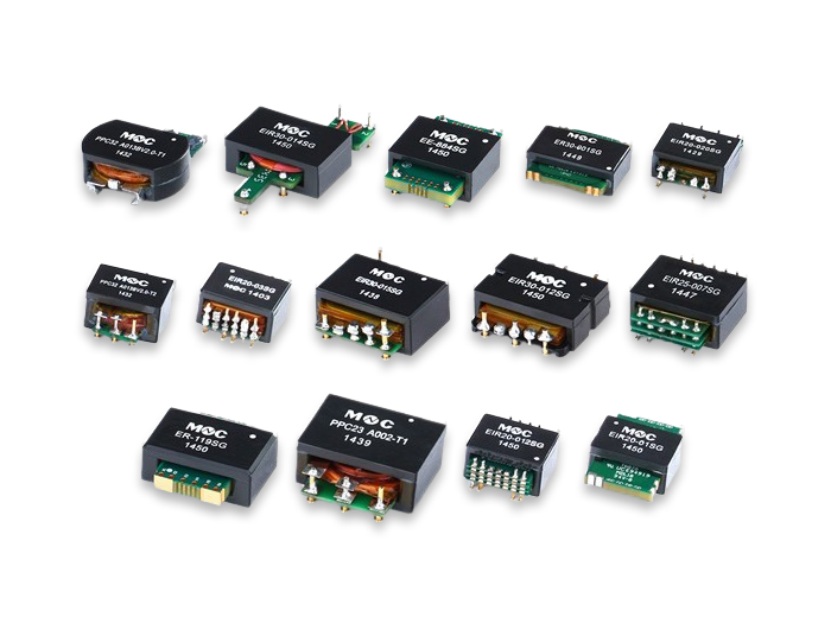
Leveraging 17 years of experience in magnetic component R&D, Mentech provides a range of high-reliability, automotive-grade inductors for new energy vehicles, meeting the demands of extreme conditions and high performance.

Mentech-Automotive-Inductor.png


Compared to finished products of the same model made with the traditional cold-pressing process, the finished products manufactured with our self-developed new T+U hot-pressing process have the following advantages:

1.  Size is reduced by 2.9%, DCR is lowered by 64.4%, temperature rise current is increased by 166.6%, and saturation current is boosted by 22.3% (as shown in Figure 1).

2.  Compared to the same product models, as the current increases (as shown in Figure 2), its saturation current curve descends more slowly than that of products made with traditional processes; the temperature of our molded inductor products increases more gradually with the load current, while the temperature rise curve of traditional inductors increases sharply.

3.  Axial compression deformation is only 4.2% (as shown in Figure 3); in aging tests, it also exhibits a longer lifespan. (Traditional molded products will experience a failure in electrical performance after about 1,300 hours of aging tests, whereas T+U process products can last for over 1,800 hours.)

T+U热压VS冷压工艺性能参数.png

Figure 1. Performance Comparison of Molded Inductors Made with the T+U Process vs. Traditional Cold Pressing


Figure 2. Saturation and Temperature Rise Curves for Molded Inductors Produced by the T+U Process vs. Traditional Cold Pressing 

Figure 2. Saturation and Temperature Rise Curves for Molded Inductors Produced by the T+U Process vs. Traditional Cold Pressing


Figure 3. Coil Deformation Comparison of Molded Inductors Made with the T+U Process vs. Traditional Cold Pressing (traditional process - right) 

Figure 3. Coil Deformation Comparison of Molded Inductors Made with the T+U Process vs. Traditional Cold Pressing (traditional process - right)


Explore how Mentech's advanced molding processes technology can elevate your automotive designs.

Contact us today to discuss your specific project needs and discover a new standard in inductor reliability and performance.